In short
- Depending on the method, the average error for calories in 52 papers was between 0.1 and 38.3 %.[1]
- Current chat models were off by about 30 to 36 % in tests, mostly too low for large portions.[2][3]
- If you add ingredients and amounts, the error falls clearly.[3]
- People estimate badly too. That makes a range more honest than an exact number.[4]
What studies show about accuracy
One review looked at 52 papers on AI and food photos. For calories, average errors were between 0.1 and 38.3 %, and lower for simple foods. The authors did not consider the technique ready to be used as the only method.[1]
Since then, language models have arrived that everybody has on their phone. In a test with 52 photos, two well-known models were off by 35.8 % on average for calories. All models estimated too low, and the larger the portion, the more so.[2] The models of that time are older now, newer ones may be better.
The simplest trick: add a sentence
| What the AI was given | Average error |
|---|---|
| The photo only | 123 kcal[3] |
| Photo with extra details | 92 kcal[3] |
| Photo with ingredients and amounts | 53 kcal[3] |
That comes from a test with 195 dishes. Each dish ran through only once, and most images came from the internet.[3] The direction is clear all the same: if you add fried in one tablespoon of oil or 200 g pasta, you get a much better estimate.
What a photo does not show
- Oil, butter and cream. They make up many calories and disappear in the dish.
- Sugar in drinks and sauces. A glass of cola looks like a glass of diet cola.
- The depth of bowls. From above, a full bowl looks like half a bowl.
- Protein. Whether there is chicken or tofu in the curry, AI often cannot tell for sure.
Are people better?
Hardly. In fast food restaurants, 1,877 adults underestimated their meal by 175 kcal on average, and larger meals by more.[4] Even a package gives no exact value: for foods with 10 to 40 g of protein, sugar or fat per 100 g, food control allows a tolerance of 20 %.[5]
If you want to know your portion exactly, you need kitchen scales and a barcode. If you only want to see whether a day is closer to 1,600 or 2,400 kcal, for example at the end of a normal week, photos will do.
How to take a useful photo
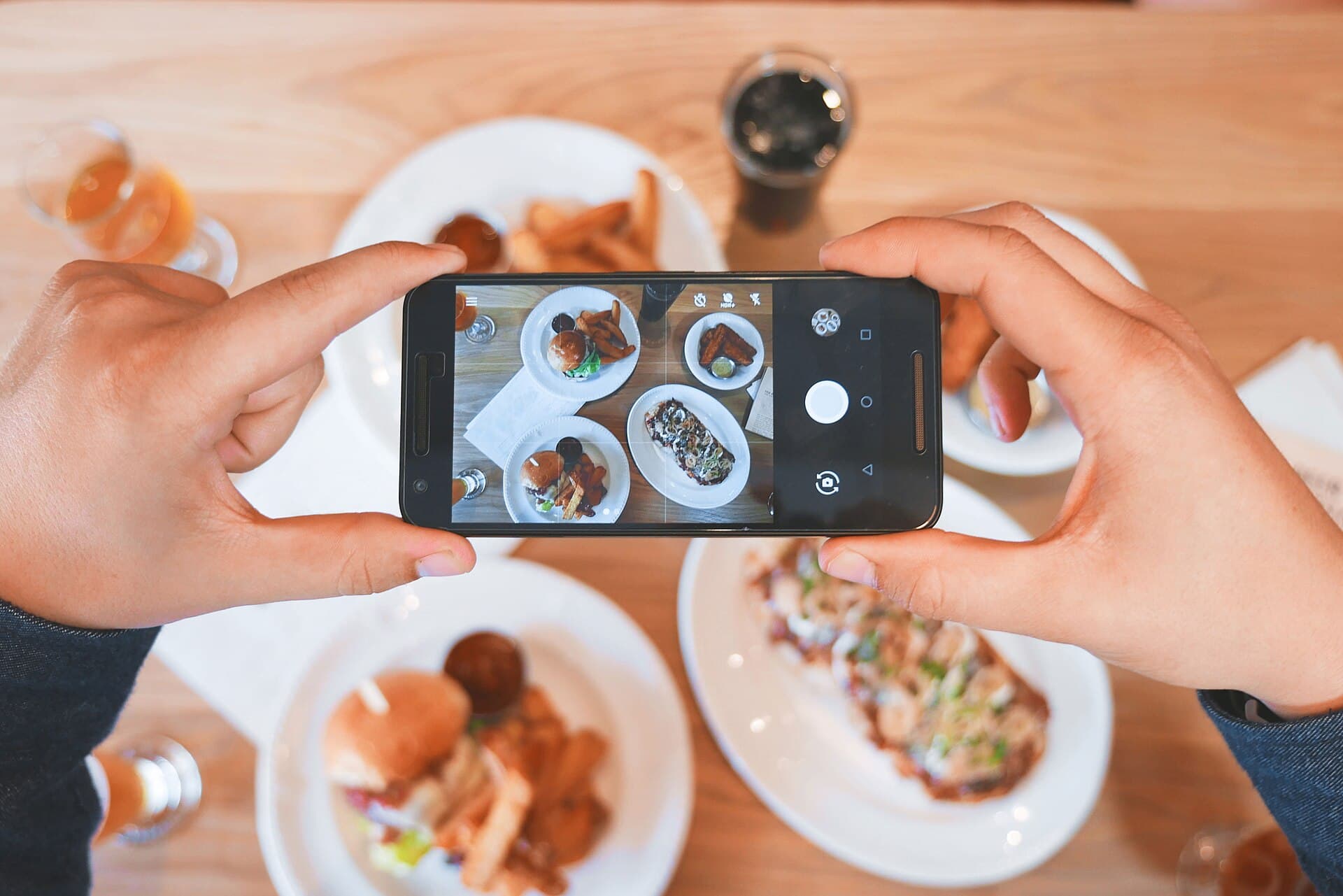
- Take it at an angle from the side so the height shows.
- Put cutlery or a glass in the picture, that helps with size.
- Show everything at once, including drink, bread and sauce.
- Add oil, sugar and amounts in words.
- Check the result and change it if it is wrong. You were there when it was cooked, the AI was not.
Also look at what else is in the picture. Faces, letters and receipts do not belong there.
How we do it
In our app a photo becomes a range and no number that looks exact. You see the estimate before it goes into your diary and can change it. Without Premium the number of photos per day is limited, because every estimate costs us money.
The estimate is made by an AI provider, and photos may be processed outside the EU for it. What exactly happens is under AI in the app. Why we show ranges is explained in Why the app shows ranges.
Common questions
Which app counts calories by photo for free?
Most large apps put the photo in their subscription. With us a limited number per day is free. You find the comparison under Free calorie counter apps.
Can ChatGPT count calories?
It can estimate, but not count. In a test with 195 dishes, ChatGPT-5 was off by 123 kcal on average with a photo alone, and by 53 kcal with ingredients and amounts.[3] It does not keep a diary on its own.
Is that good enough for losing weight?
As a guide, often yes. If your weight does not match over weeks, weigh your food for a few days. Common reasons are under Why am I not losing weight?
Why does AI estimate the same food differently twice?
Because it guesses anew each time. Light, angle and chance change the result. For dishes you eat often, use a saved entry.
Background in the knowledge area
This text informs and does not replace medical advice. It is written for healthy adults aged 18 and over. If you are pregnant or breastfeeding, have an illness, or have or had an eating disorder, please read When to see a doctor first.
Sources
- Shonkoff E et al.: AI-based digital image dietary assessment methods compared to humans and ground truth: a systematic review. Ann Med, 2023
- Fridolfsson J et al.: Vergleich von KI-Modellen bei der Schätzung von Nährwerten aus Fotos. Curr Dev Nutr, 2025
- Rodríguez-Jiménez M et al.: Schätzung von Nährwerten mit ChatGPT-5. Nutrients, 2025
- Block JP et al.: Consumers' estimation of calorie content at fast food restaurants. BMJ, 2013
- European Commission: Guidance document on tolerances for nutrient values declared on a label, 2012